
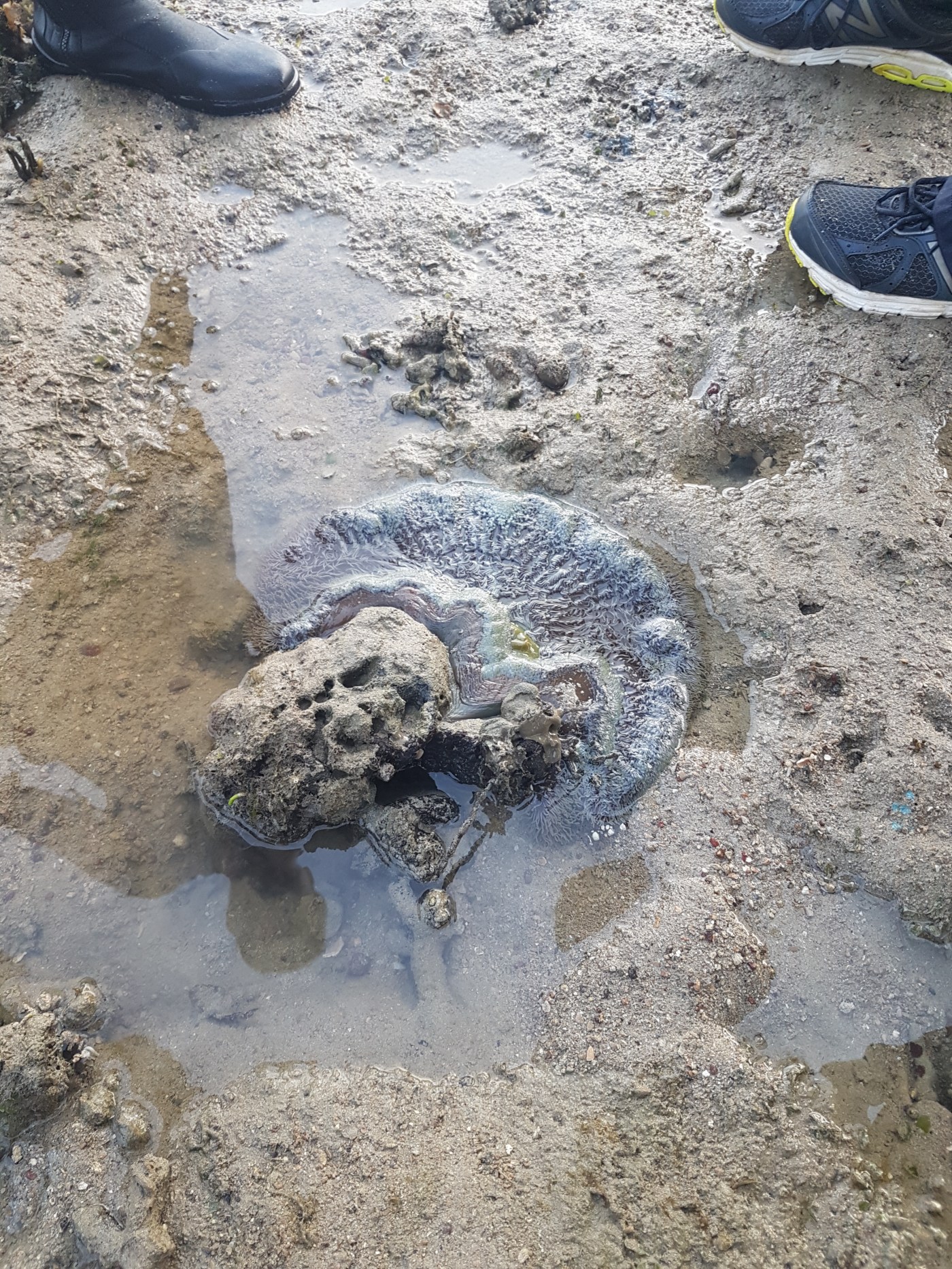


On the intertidal walk, we’d gotten to see some really interesting little guys called carpet anemones, which kind of look like shaggy carpets (see above image). The anemones in the pictures above were not identified, but from pictorial comparisons are most likely a giant carpet anemone (Stichodactyla gigantea) which can be found on Pulau Semakau. (The ones we had seen ranged in size from small to large)

Carpet anemones are commonly found on Singapore’s southern shores, are sometimes mistaken for soft corals, and like corals, they are cnidarians and hence share similar adaptational features, such as the presence of stingers and tentacles. However, they can be distinguished by their single polyp structure and the presence of a central mouth. They typically exist as single polyps, but unlike jellyfish, lack a medusa stage in their life cycle. Sea anemones usually have a long, tubular body column with a large oral disc on the end and a mouth at the centre.
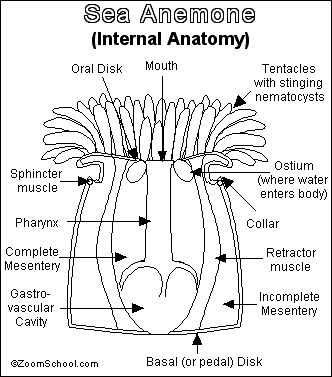
Carpet anemones tend to feed on fine particles for food. To aid them in this, surrounding the mouth are numerous tentacles with stingers (nematocysts) which can inject venom produced in the cnidocyte into prey or predators as a defence mechanism. This carpet of sticky tentacles also has the added function of trapping small particles, detritus and plankton from the water as food. However, as carpet anemones are not known to feed on larger prey such as fish, their tentacles are rather short as there is no need to wrap around large prey. Some types of stingers in other anemones may also feature a long, sticky thread known as a spirocyst to wrap around larger prey such as fish. Apart from this, anemones also get food from zooxanthellae, which are a kind of symbiotic algae which reside in the tentacles of the anemone. In exchange for protection and minerals, the zooxanthellae photosynthesize and share the produced food with the anemone.
There are also some features that are unique to anemones that help them thrive in the intertidal area. For example, at the other end of the body column is a flat muscular pedal disk, which allows the anemone to attach itself to a substrate as most sessile cnidarians do, so it can live taking advantage of the resources available in the surrounding environment. In some anemones, the pedal disk lets them move slowly. However, burrowing-type anemones more commonly possess a bulbous tip to allow it to dig into the ground rather than a pedal disc.
The body column in anemones also has the ability to retract towards its base, which allows it to hide from predators, as well as prevents dehydration or exposure at low tide. However, in the case of the carpet anemone, its body column instead is buried altogether underground or in a crevice, only exposing the oral disc as seen in the image above. They also can tuck their tentacles in to prevent unnecessary exposure. The body column may also have some bumps called verrucae which provide added friction for securing itself to its surroundings, particularly when it is burrowing into the ground, or when spreading its oral disc out to maximise its surface area for trapping food.
As we can see, carpet anemones are truly fascinating creatures. However, even though it is technically known to be not threatened in Singapore waters, they are commonly harvested for the aquarium trade, where most of them do not thrive and die shortly after in captivity. As such, we should be more aware of these dangers and take a stand in protecting our marine wildlife.
Sources:
- http://www.wildsingapore.com/wildfacts/cnidaria/actiniaria/gigantea.htm
- http://www.wildsingapore.com/wildfacts/cnidaria/actiniaria/magnifica.htm
- http://www.wildsingapore.com/wildfacts/cnidaria/actiniaria/stichodactyla.htm
- http://www.wildsingapore.com/wildfacts/cnidaria/actiniaria/actiniaria.htm
- Image of carpet: https://www.ebay.com/itm/Shaggy-Microfibre-Bathroom-Shower-Bath-Mat-Rug-Carpet-Non-Slip-Backing-60x40cm-/332230856607
- Diagram of sea anemone: https://www.enchantedlearning.com/subjects/invertebrates/seaanemone/Seaanemoneprintout.shtml
 The Biodiversity Press
Leave a comment