
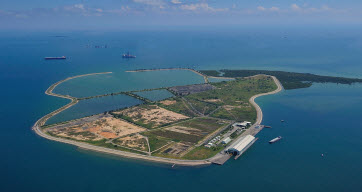
This article will be on the threats and the conservation efforts of the rich biodiversity in Pulau Semakau.
How magnificent the ecosystem of the reef of Pulau Semakau, a plethora of flora and fauna can be found! Devastatingly, these animals won’t be here for long. As years pass by, the condition of these animals’ home are getting worse and worse.
Threats Faced
Let’s start with global warming, which is a prevalent issue currently. Global warming causes the sea water temperatures to rise. As the temperature of the water rises, there is a high probability that the corals will undergo coral bleaching. Coral bleaching happens when the coral polyps releases their zooxanthellae, which they rely heavily on to receive food and oxygen. After a prolonged period of coral bleaching, the coral will start to degrade and die. On top of that, many animals need corals to protect them, and the bleaching of the corals will result in the loss of habitats of these poor animals, and hence a significant decrease in the biodiversity at the coral reefs.
If you take a walk along the beaches of Singapore – for example, Pasir Ris Beach, it is not uncommon to find man-made waste materials on the shores, or even floating in the waters of Singapore. These waste, such as indecomposable plastics and metals can cause a lot of harm to the aquatic life as it travels to the nearby reefs like the reefs at Pulau Semakau. These plastics and metal pieces might be mistaken as food, and if the animals try to ingest it, they may choke on these waste materials and eventually die.
Pulau Semakau is used mainly as a landfill, for the trash generated by the mainland. However, the island had limited space, hence, they used a 157-hectare see space to build a cell to fill in with trash. However, since there is a presence of freshwater in the lagoon, marine habitats started to flourish. However, since the cell is unfortunately used as a dumping area for the trash and the ashes of the trash, the conditions after the addition of the waste materials can also cause the corals to die, and as explained above, can also greatly reduce the biodiversity in the area.
Conservation Efforts
Fortunately, there are several conservation efforts to maintain the flourishing biodiversity in Pulau Semakau.
Before starting to fill the 157-hectare cell with trash in 2016, NEA (National Environmental Agency) commissioned an independent coral reef survey of the lagoon in March 2014, in which they found many different genera of corals and sponges, some of them very rare in Singapore, such as the Neptune’s Cup Sponge. In July 2014, a tender was called to relocate the corals and a few months later, the corals were successfully planted at the Sisters’ Islands Marine Park.

In 2007, a coral nursery was established in Pulau Semakau. This nursery uses an innovative method of taking fragmented corals (instead of breaking of from healthy corals as done conventionally) as seed corals for growth and transplantation.
In 2008, HSBC has collaborated with the Raffles Museum of Biodiversity Research (RMBR) to launch an important initiative at Pulau Semakau, known as Project Semakau. Working alongside NEA, this project aims to promote and conserve the biodiversity in the intertidal shores of Pulau Semakau through many different outreach and research programmes with the help of volunteers. However, this project only lasted for three years.
Our Thoughts
Although there were some efforts from nature groups and NEA to try to save and conserve the rich biodiversity of the reefs of Pulau Semakau, we feel that there is still a lack of actions or activities to provide outreach and to educate Singaporeans on the rich biodiversity of Pulau Semakau. As passionate science students, it was quite a shock that most of us did not know, before the trip, that Pulau Semakau has a rich biodiversity even though it is used as a landfill. With that, to raise awareness of the rich biodiversity of Singapore and Pulau Semakau in our school, one of our members, Lutfir Rahman, who is an Art student, decided to create an artwork relating to the different animals that can be found in Singapore, which will be exhibited during the Art Graduation Show 2018.

References:
- Ms Mindy (one of the nature tour guides)
- https://www.straitstimes.com/singapore/singapore-ready-to-deal-with-threat-to-corals
- https://www.nea.gov.sg/media/releases/news/index/phase-ii-semakau-landfill-ready-to-meet-singapore-s-waste-disposal-needs-to-2035-and-beyond
- https://www.nparks.gov.sg/biodiversity/our-national-plan-for-conservation/strategies-and-actions
- https://lkcnhm.nus.edu.sg/projectsemakau/index.php?option=com_semakau_events&task=details&id=6
 The Biodiversity Press
Leave a comment